The Hidden User Lifecycle in Ads Monetization Strategy
Users aren't resisting revenue features. They're at the wrong lifecycle stage. Behavioral incentives drive short-term action, but long-term monetization requires systems that adapt as streamers evolve from prioritizing audience growth to optimizing revenue.
TL;DR
Overview
When I joined Kikoff, the growth team was optimizing without any model of who they were optimizing for. That is a strategic risk at any company — but at a high-growth fintech building credit and financial wellness products for consumers largely underserved by traditional financial infrastructure, it meant features were shipping without a behavioral foundation and retention strategy had no consumer model to build from. There was no research infrastructure and no user segmentation. The gap was structural, not incidental.
I identified that gap and made the case for user segmentation research before the personalization work moved further. This wasn't on the roadmap. I pitched it, framed it as a retention risk, and ran it.

Research Approach
Because there was no established research infrastructure and the roadmap was already in motion, data collection was naturalistic across three channels rather than structured by a fixed protocol.
- Live call observation: I listened to customer calls in real time without a fixed observation framework. The organizational conditions didn't allow for structured interference, so the approach was unstructured but purposive: designed to surface unfiltered sentiment and behavioral context as it emerged.
- Analytics data: Direct pulls from Amplitude to map where users were going, where they dropped, and what the journey indicated about unmet needs.
- Marketing insight synthesis: Examining acquisition channels to assess whether incoming messaging reflected the consumers the product was actually serving.
This was convergent data collection: not accuracy-checking across sources, but layering them to build depth and surface the human context that no single channel could provide alone.

Findings
Three distinct behavioral patterns emerged across the data, each reflecting a different relationship with the product.
- Non-Returners: Signed up but never came back. Trust was not established at the onboarding moment, and the product gave them no reason to return.
- Occasional Checkers: Returned sporadically. Passive interest existed, but without enough clarity or motivation to sustain engagement.
- Active Builders: Consistently engaged, using Kikoff as an active tool toward a specific financial goal.
What live call observation added beneath the behavioral data was a cross-segment finding: every group, regardless of engagement level, was navigating some form of financial stress.

Framework
Financial stress reframed the strategic question. The research had started as a segmentation problem. Financial stress doesn't just shape behavior, it shapes how much risk a person is willing to take with something unfamiliar. That made it a trust problem, not an engagement problem. The question was no longer how to increase engagement in the abstract. It shifted to how personalization efforts might account for the emotional conditions underneath the behavioral patterns. Without that context, optimization could have been targeting the wrong variable.
The segmentation framework changed how product and design approached personalization strategy. Before it existed, decisions were driven largely by competitive observation: borrowing patterns from other platforms rather than building from an understanding of Kikoff's own consumers. The organization was looking outward when the behavioral data was internal.
The framework gave product a foundation for personalization targeting built on behavioral understanding. It gave design consumer context for onboarding grounded in actual user goals rather than industry convention. Two teams now had a shared model for who they were building for.

Impact
Within four months of implementation, retention improved 12% against baseline. The segmentation framework gave the personalization strategy a behavioral target it had not previously had.

Decision and rationale
The feature launched with two distinct pathways to balance social cost against streamer visibility. Within three months it reached 100% of platform users and produced a 94% lift in overall engagement. That lift expanded the top of the funnel for micro-transaction opportunities by activating a segment that had previously sat outside the conversion architecture. The findings also shaped a longer-term product recommendation rooted in loss aversion and the goal gradient effect, proposing progress visualizations that rewarded return behavior over time — a durable framework for converting ambient engagement into active participation well after the launch window closed.
Methods
- Semi-structured interviews and moderated usability testing across 18 streamers recruited along a purposive spectrum from new affiliates to early-to-mid-level partners
- Sessions continued until behavioral patterns around monetization decision-making reached saturation, meaning new sessions were no longer surfacing novel mental models about the growth versus revenue trade-off

Insights and findings
The feature launched with two distinct pathways to balance social cost against streamer visibility. Within three months it reached 100% of platform users and produced a 94% lift in overall engagement. That lift expanded the top of the funnel for micro-transaction opportunities by activating a segment that had previously sat outside the conversion architecture. The findings also shaped a longer-term product recommendation rooted in loss aversion and the goal gradient effect, proposing progress visualizations that rewarded return behavior over time — a durable framework for converting ambient engagement into active participation well after the launch window closed.
Implications and outcomes
Implications and outcomes
The feature launched with two distinct pathways to balance social cost against streamer visibility. Within three months it reached 100% of platform users and produced a 94% lift in overall engagement. That lift expanded the top of the funnel for micro-transaction opportunities by activating a segment that had previously sat outside the conversion architecture. The findings also shaped a longer-term product recommendation rooted in loss aversion and the goal gradient effect, proposing progress visualizations that rewarded return behavior over time — a durable framework for converting ambient engagement into active participation well after the launch window closed.
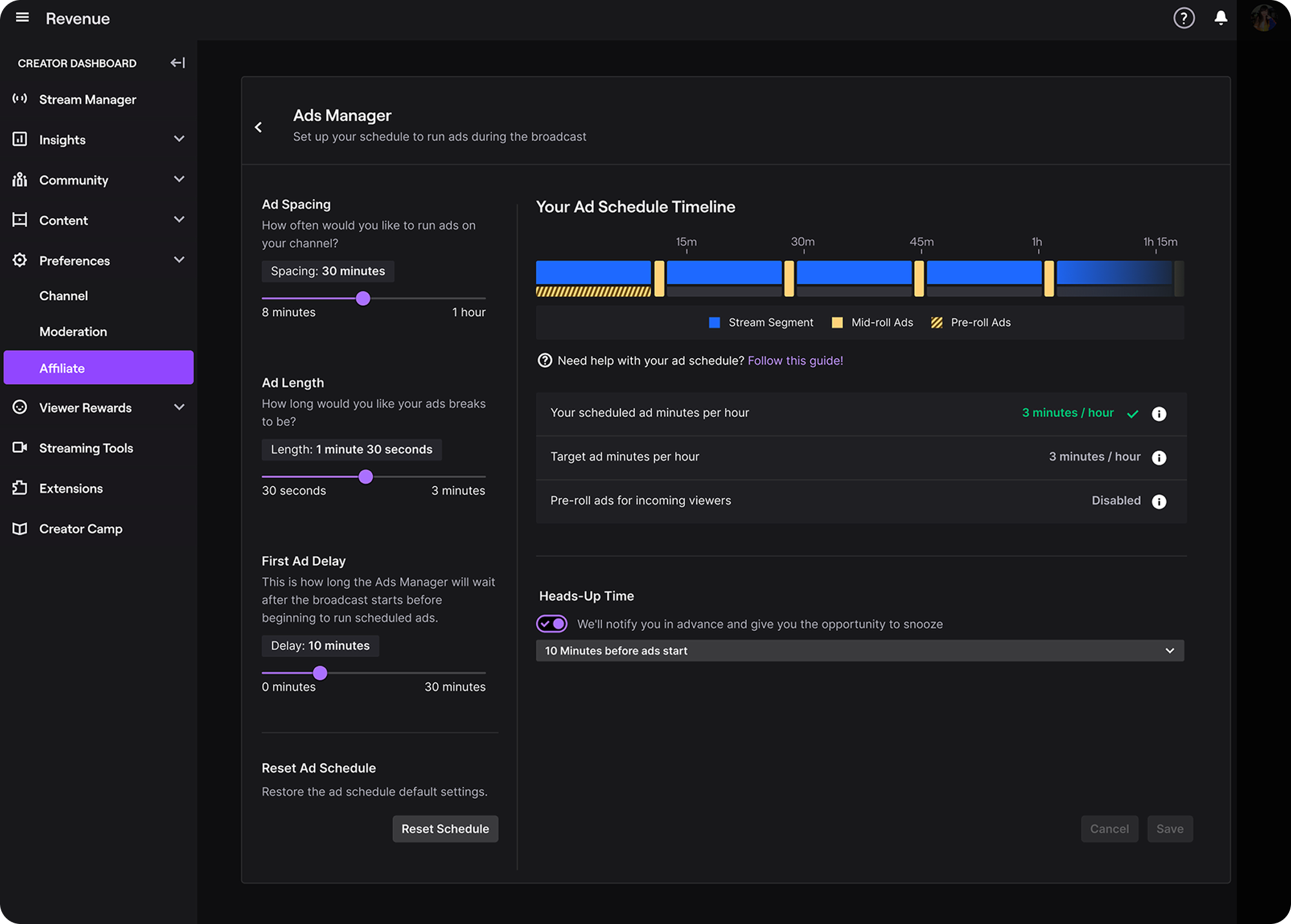
The Ads Manager Redesign
The feature launched with two distinct pathways to balance social cost against streamer visibility. Within three months it reached 100% of platform users and produced a 94% lift in overall engagement. That lift expanded the top of the funnel for micro-transaction opportunities by activating a segment that had previously sat outside the conversion architecture. The findings also shaped a longer-term product recommendation rooted in loss aversion and the goal gradient effect, proposing progress visualizations that rewarded return behavior over time — a durable framework for converting ambient engagement into active participation well after the launch window closed.

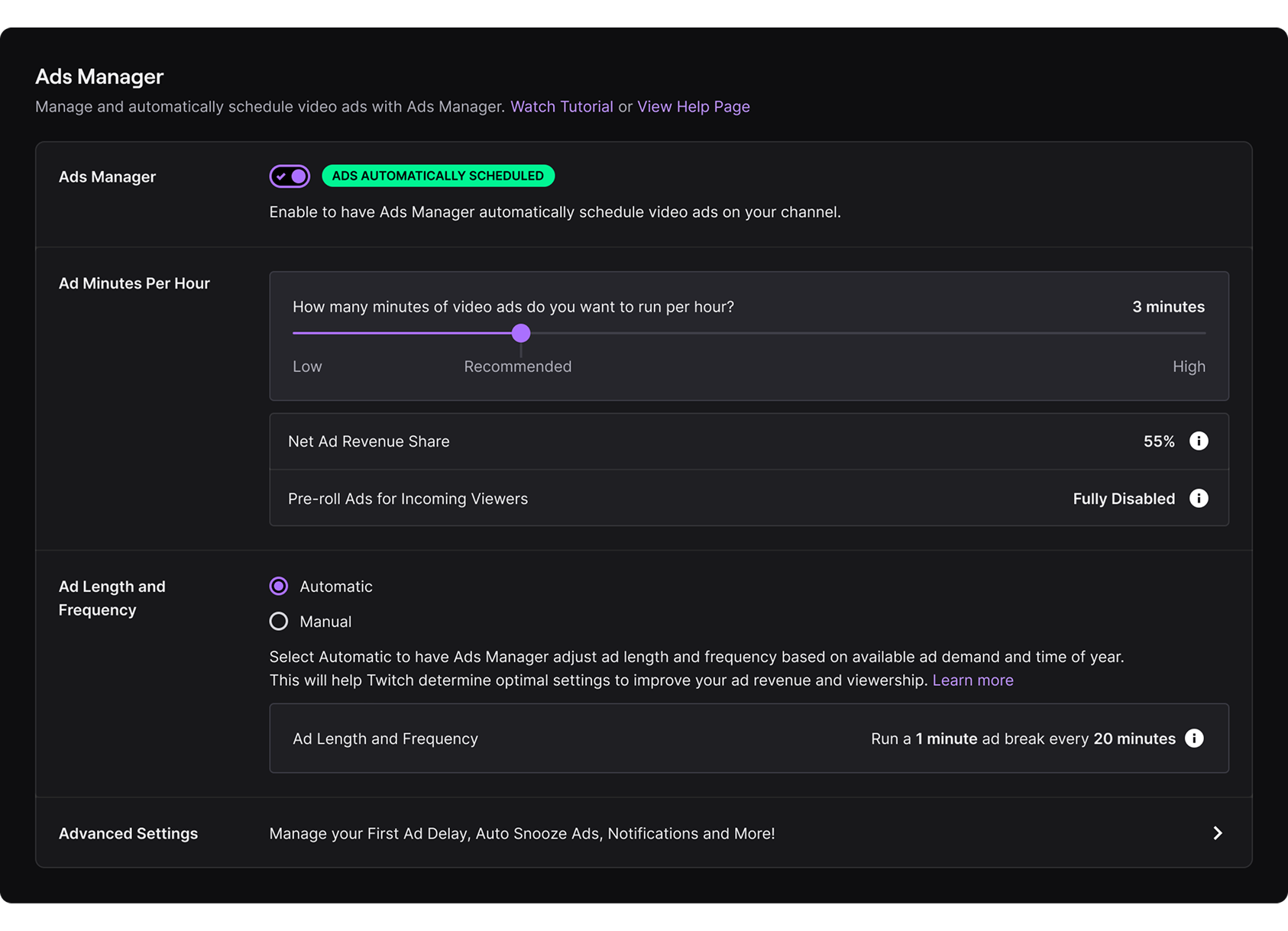
Reflection
The feature launched with two distinct pathways to balance social cost against streamer visibility. Within three months it reached 100% of platform users and produced a 94% lift in overall engagement. That lift expanded the top of the funnel for micro-transaction opportunities by activating a segment that had previously sat outside the conversion architecture. The findings also shaped a longer-term product recommendation rooted in loss aversion and the goal gradient effect, proposing progress visualizations that rewarded return behavior over time — a durable framework for converting ambient engagement into active participation well after the launch window closed.
My background spanning HCI and design shaped how the findings left my hands. Rather than prescribing a direction while the team still needed to learn from the incentive program, I framed the research around conditional paths — here is what the evidence suggests if the team moves in one direction, here is the risk if it moves in another, and here is what remains unanswered that would reduce that risk before committing. That is not recommendation-making. It is giving PMs and designers the behavioral scaffolding to make better product decisions in spaces where research cannot yet be conclusive.




“Expanding perspectives into deliberate insight for bolder moves”


Made and designed by nayeri
© 2026 All Rights Reserved

The Hidden User Lifecycle in Ads Monetization Strategy
Users aren't resisting revenue features. They're at the wrong lifecycle stage. Behavioral incentives drive short-term action, but long-term monetization requires systems that adapt as streamers evolve from prioritizing audience growth to optimizing revenue.
TL;DR
Overview
When I joined Kikoff, the growth team was optimizing without any model of who they were optimizing for. That is a strategic risk at any company — but at a high-growth fintech building credit and financial wellness products for consumers largely underserved by traditional financial infrastructure, it meant features were shipping without a behavioral foundation and retention strategy had no consumer model to build from. There was no research infrastructure and no user segmentation. The gap was structural, not incidental.
I identified that gap and made the case for user segmentation research before the personalization work moved further. This wasn't on the roadmap. I pitched it, framed it as a retention risk, and ran it.

Research Approach
Because there was no established research infrastructure and the roadmap was already in motion, data collection was naturalistic across three channels rather than structured by a fixed protocol.
- Live call observation: I listened to customer calls in real time without a fixed observation framework. The organizational conditions didn't allow for structured interference, so the approach was unstructured but purposive: designed to surface unfiltered sentiment and behavioral context as it emerged.
- Analytics data: Direct pulls from Amplitude to map where users were going, where they dropped, and what the journey indicated about unmet needs.
- Marketing insight synthesis: Examining acquisition channels to assess whether incoming messaging reflected the consumers the product was actually serving.
This was convergent data collection: not accuracy-checking across sources, but layering them to build depth and surface the human context that no single channel could provide alone.
Findings
Three distinct behavioral patterns emerged across the data, each reflecting a different relationship with the product.
- Non-Returners: Signed up but never came back. Trust was not established at the onboarding moment, and the product gave them no reason to return.
- Occasional Checkers: Returned sporadically. Passive interest existed, but without enough clarity or motivation to sustain engagement.
- Active Builders: Consistently engaged, using Kikoff as an active tool toward a specific financial goal.
What live call observation added beneath the behavioral data was a cross-segment finding: every group, regardless of engagement level, was navigating some form of financial stress.
Framework
Financial stress reframed the strategic question. The research had started as a segmentation problem. Financial stress doesn't just shape behavior, it shapes how much risk a person is willing to take with something unfamiliar. That made it a trust problem, not an engagement problem. The question was no longer how to increase engagement in the abstract. It shifted to how personalization efforts might account for the emotional conditions underneath the behavioral patterns. Without that context, optimization could have been targeting the wrong variable.
The segmentation framework changed how product and design approached personalization strategy. Before it existed, decisions were driven largely by competitive observation: borrowing patterns from other platforms rather than building from an understanding of Kikoff's own consumers. The organization was looking outward when the behavioral data was internal.
The framework gave product a foundation for personalization targeting built on behavioral understanding. It gave design consumer context for onboarding grounded in actual user goals rather than industry convention. Two teams now had a shared model for who they were building for.
Impact
Within four months of implementation, retention improved 12% against baseline. The segmentation framework gave the personalization strategy a behavioral target it had not previously had.
Decision and rationale
The feature launched with two distinct pathways to balance social cost against streamer visibility. Within three months it reached 100% of platform users and produced a 94% lift in overall engagement. That lift expanded the top of the funnel for micro-transaction opportunities by activating a segment that had previously sat outside the conversion architecture. The findings also shaped a longer-term product recommendation rooted in loss aversion and the goal gradient effect, proposing progress visualizations that rewarded return behavior over time — a durable framework for converting ambient engagement into active participation well after the launch window closed.
Methods
- Semi-structured interviews and moderated usability testing across 18 streamers recruited along a purposive spectrum from new affiliates to early-to-mid-level partners
- Sessions continued until behavioral patterns around monetization decision-making reached saturation, meaning new sessions were no longer surfacing novel mental models about the growth versus revenue trade-off
Insights and findings
The feature launched with two distinct pathways to balance social cost against streamer visibility. Within three months it reached 100% of platform users and produced a 94% lift in overall engagement. That lift expanded the top of the funnel for micro-transaction opportunities by activating a segment that had previously sat outside the conversion architecture. The findings also shaped a longer-term product recommendation rooted in loss aversion and the goal gradient effect, proposing progress visualizations that rewarded return behavior over time — a durable framework for converting ambient engagement into active participation well after the launch window closed.
Implications and outcomes
Implications and outcomes
The feature launched with two distinct pathways to balance social cost against streamer visibility. Within three months it reached 100% of platform users and produced a 94% lift in overall engagement. That lift expanded the top of the funnel for micro-transaction opportunities by activating a segment that had previously sat outside the conversion architecture. The findings also shaped a longer-term product recommendation rooted in loss aversion and the goal gradient effect, proposing progress visualizations that rewarded return behavior over time — a durable framework for converting ambient engagement into active participation well after the launch window closed.
The Ads Manager Redesign
The feature launched with two distinct pathways to balance social cost against streamer visibility. Within three months it reached 100% of platform users and produced a 94% lift in overall engagement. That lift expanded the top of the funnel for micro-transaction opportunities by activating a segment that had previously sat outside the conversion architecture. The findings also shaped a longer-term product recommendation rooted in loss aversion and the goal gradient effect, proposing progress visualizations that rewarded return behavior over time — a durable framework for converting ambient engagement into active participation well after the launch window closed.
Reflection
The feature launched with two distinct pathways to balance social cost against streamer visibility. Within three months it reached 100% of platform users and produced a 94% lift in overall engagement. That lift expanded the top of the funnel for micro-transaction opportunities by activating a segment that had previously sat outside the conversion architecture. The findings also shaped a longer-term product recommendation rooted in loss aversion and the goal gradient effect, proposing progress visualizations that rewarded return behavior over time — a durable framework for converting ambient engagement into active participation well after the launch window closed.
My background spanning HCI and design shaped how the findings left my hands. Rather than prescribing a direction while the team still needed to learn from the incentive program, I framed the research around conditional paths — here is what the evidence suggests if the team moves in one direction, here is the risk if it moves in another, and here is what remains unanswered that would reduce that risk before committing. That is not recommendation-making. It is giving PMs and designers the behavioral scaffolding to make better product decisions in spaces where research cannot yet be conclusive.
What would you like to Read next?
Finding Signal Without Infrastructure
Integrating the Monetization Funnel
“Expanding perspectives into deliberate insight for bolder moves”

Made and designed by nayeri
© 2026 All Rights Reserved
The Hidden User Lifecycle in Ads Monetization Strategy
Users aren't resisting revenue features. They're at the wrong lifecycle stage. Behavioral incentives drive short-term action, but long-term monetization requires systems that adapt as streamers evolve from prioritizing audience growth to optimizing revenue.
TL;DR
Overview
When I joined Kikoff, the growth team was optimizing without any model of who they were optimizing for. That is a strategic risk at any company — but at a high-growth fintech building credit and financial wellness products for consumers largely underserved by traditional financial infrastructure, it meant features were shipping without a behavioral foundation and retention strategy had no consumer model to build from. There was no research infrastructure and no user segmentation. The gap was structural, not incidental.
I identified that gap and made the case for user segmentation research before the personalization work moved further. This wasn't on the roadmap. I pitched it, framed it as a retention risk, and ran it.
Research Approach
Because there was no established research infrastructure and the roadmap was already in motion, data collection was naturalistic across three channels rather than structured by a fixed protocol.
- Live call observation: I listened to customer calls in real time without a fixed observation framework. The organizational conditions didn't allow for structured interference, so the approach was unstructured but purposive: designed to surface unfiltered sentiment and behavioral context as it emerged.
- Analytics data: Direct pulls from Amplitude to map where users were going, where they dropped, and what the journey indicated about unmet needs.
- Marketing insight synthesis: Examining acquisition channels to assess whether incoming messaging reflected the consumers the product was actually serving.
This was convergent data collection: not accuracy-checking across sources, but layering them to build depth and surface the human context that no single channel could provide alone.
Findings
Three distinct behavioral patterns emerged across the data, each reflecting a different relationship with the product.
- Non-Returners: Signed up but never came back. Trust was not established at the onboarding moment, and the product gave them no reason to return.
- Occasional Checkers: Returned sporadically. Passive interest existed, but without enough clarity or motivation to sustain engagement.
- Active Builders: Consistently engaged, using Kikoff as an active tool toward a specific financial goal.
What live call observation added beneath the behavioral data was a cross-segment finding: every group, regardless of engagement level, was navigating some form of financial stress.
Framework
Financial stress reframed the strategic question. The research had started as a segmentation problem. Financial stress doesn't just shape behavior, it shapes how much risk a person is willing to take with something unfamiliar. That made it a trust problem, not an engagement problem. The question was no longer how to increase engagement in the abstract. It shifted to how personalization efforts might account for the emotional conditions underneath the behavioral patterns. Without that context, optimization could have been targeting the wrong variable.
The segmentation framework changed how product and design approached personalization strategy. Before it existed, decisions were driven largely by competitive observation: borrowing patterns from other platforms rather than building from an understanding of Kikoff's own consumers. The organization was looking outward when the behavioral data was internal.
The framework gave product a foundation for personalization targeting built on behavioral understanding. It gave design consumer context for onboarding grounded in actual user goals rather than industry convention. Two teams now had a shared model for who they were building for.
Impact
Within four months of implementation, retention improved 12% against baseline. The segmentation framework gave the personalization strategy a behavioral target it had not previously had.
Decision and rationale
During my audit of the existing Ads Manager experience, I began to suspect the team was addressing a symptom rather than the condition underneath it. Before framing a research approach, I had a conversation with the PM to understand where his confidence in the incentive-first direction actually stood, what he expected it to surface, and where his own hesitations lived. That conversation confirmed the team was navigating genuine uncertainty about whether the strategy would hold. The research was not on the roadmap. I pitched it into that gap and designed it to run in parallel with the incentive program launch rather than waiting for results that might take months to materialize.
Methods
- Semi-structured interviews and moderated usability testing across 18 streamers recruited along a purposive spectrum from new affiliates to early-to-mid-level partners
- Sessions continued until behavioral patterns around monetization decision-making reached saturation, meaning new sessions were no longer surfacing novel mental models about the growth versus revenue trade-off
Insights and findings
Streamers did not think the ROI justified the risk. Running ads meant accepting an immediate threat to viewer retention in exchange for a revenue amount that was uncertain and historically modest. This was not a knowledge gap the incentive program could close on its own. It was a trust gap rooted in a cost-benefit calculus that kept returning a negative answer.
- The trade-off logic: Disabling pre-rolls while committing to more mid-roll ads is a more favorable exchange because it removes the highest-friction moment for incoming viewers while preserving ad revenue during established viewing sessions
- The information gap: Ads Manager showed streamers how many ad minutes they wanted to run and for how long. That was the extent of it. No estimated earnings, no benchmarks, no signal of what a given configuration would actually mean for their channel. A tool designed for simplicity had created a decision environment where streamers were committing to a revenue strategy without any data to reason from
Implications and outcomes
Implications and outcomes
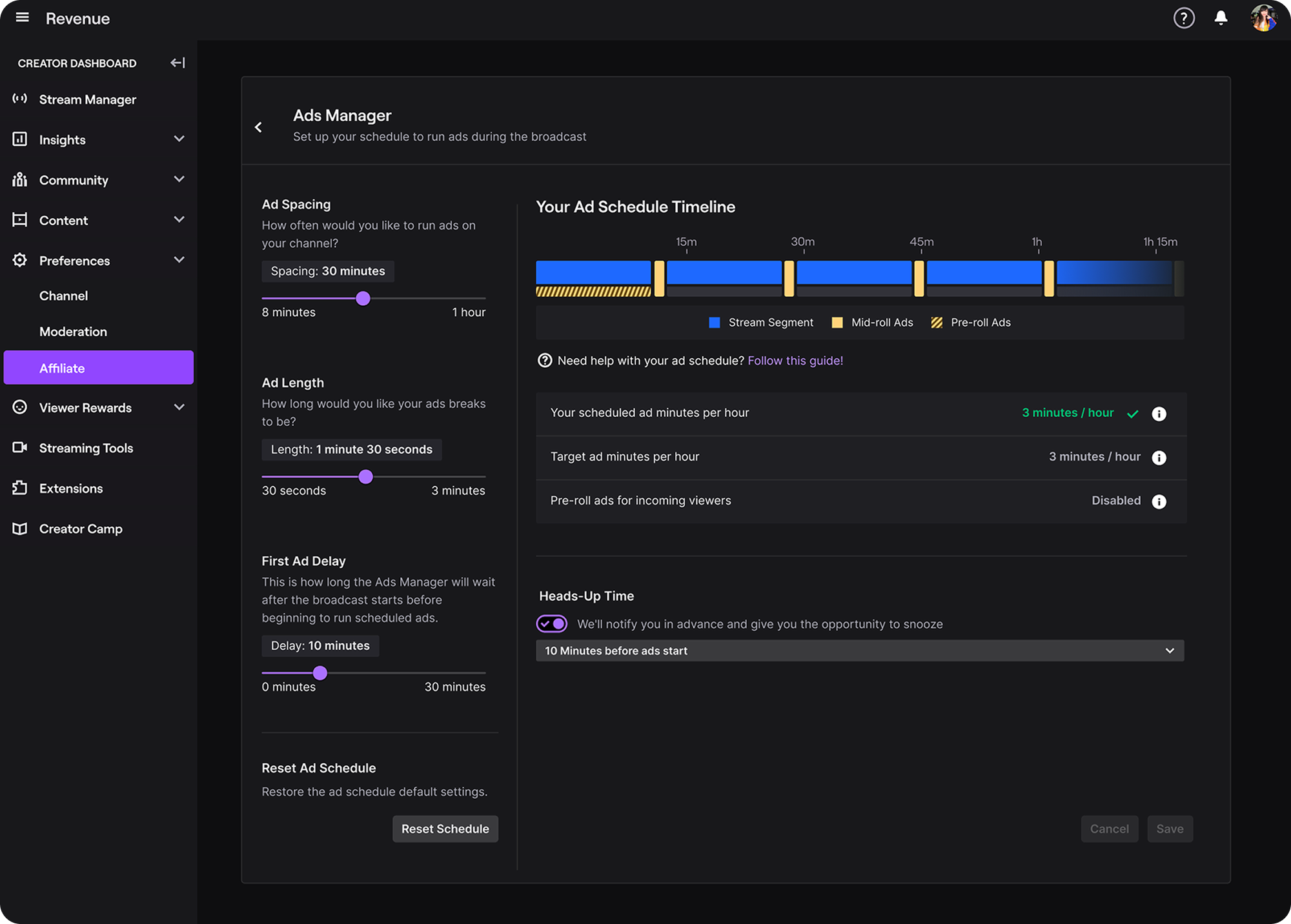
The research produced two distinct outcomes that reflect different levels of influence. The first was a direct deliverable: findings shaped the design of the pre-roll disable UI, giving streamers visibility into trade-off consequences at the exact moment they were configuring their ad settings. The second was a longer-term signal: the behavioral case this research made for adaptive information architecture is visible in how Ads Manager was eventually redesigned, though that was a roadmap conversation this work helped start rather than a unilateral outcome it produced.
The Ads Manager Redesign
The research identified a Progressive Disclosure failure: a universal interface that exposed granular controls to growth-stage streamers who had no monetization history to use them, while failing to serve established partners who needed that same granularity to optimize. The redesigned Ads Manager, which moves complexity behind an Advanced Settings section, reflects the architectural direction this research pointed toward.
Reflection
Before a single session was conducted, I ran a diagnostic conversation with the PM to understand where organizational confidence in the incentive-first strategy actually stood. That conversation is not a soft skill — it is a research method. Auditing whether the question on the table is the question worth answering is the work that makes everything downstream more honest and more useful.
My background spanning HCI and design shaped how the findings left my hands. Rather than prescribing a direction while the team still needed to learn from the incentive program, I framed the research around conditional paths — here is what the evidence suggests if the team moves in one direction, here is the risk if it moves in another, and here is what remains unanswered that would reduce that risk before committing. That is not recommendation-making. It is giving PMs and designers the behavioral scaffolding to make better product decisions in spaces where research cannot yet be conclusive.
What would you like to Read next?
Finding Signal Without Infrastructure
Mapping the Spectrum of Engagement
“Expanding perspectives into deliberate insight for bolder moves”
Made and designed by nayeri
© 2026 All Rights Reserved